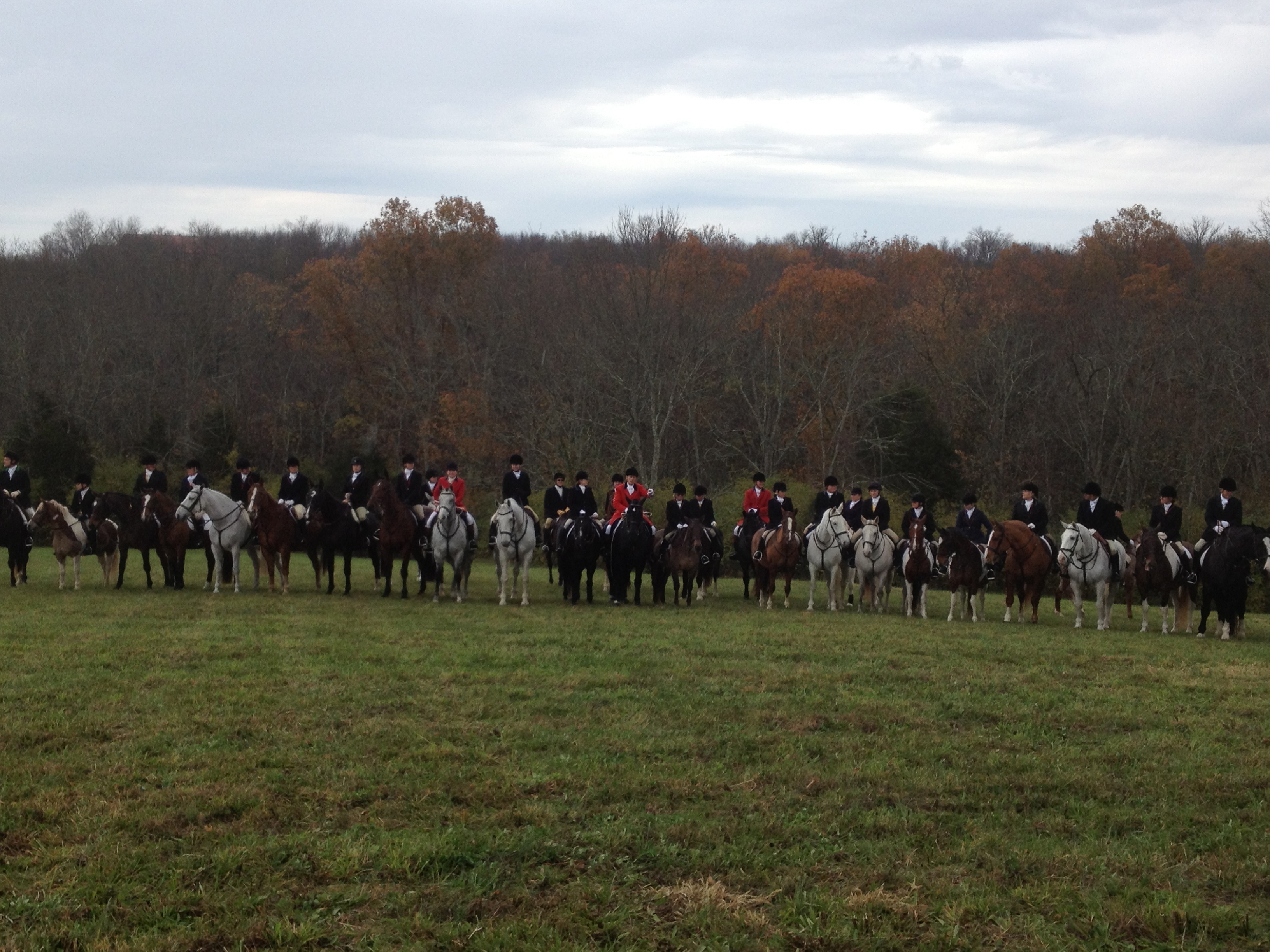
November 20, 2009

And another for the Full Cry Film Fest …

OH my goodness, I just found this one. Beautiful! Enjoy!

November 19, 2009

Some of the best of YouTube

WE’RE still in the deer season doldrums, when our hunting pauses; our huntsman is sidelined with a leg injury; and I’ve been watching a horse sale where the prices are dropping. Sounds like a good time to import some good cheer!

Over the last few nights I’ve spent some happy hours toodling around YouTube to see what good hound and foxhunting videos and slideshows I could find. Here are a few I’ve come up with.

David Ryan is a photographer in Ireland whose photos are tremendous. Below is a photo slideshow from his day following the Galway Blazers, set to excellent music. Some of these will just make you sigh, they’re so beautiful. A few others will make you laugh (fall in the mud, anyone? Been there, done that?). And there’s an early one of a hound trying to get through a closed gate that is just downright puzzling (how did he do that?).

The one below is from England, and I post it here mainly for the very good scenes of hounds. And there are some woollies! The huntsman’s monologue also holds interest in that it shows the deep concerns hunt staff and hunting folk generally had in the lead up to England’s foxhunting ban.

Next is a two-minute photo slide show that shows all the ambience of an American hunt, presented by the Washington Times and featuring the Bull Run hunt.

Hikers’ chance encounter with the Dartmoor resulted in this brief clip. Features more horn than hounds, but it’s nice nonetheless. And listen to that wind on the moors!

The next video is from a HorseTV piece about foxhunting (also videoed pre-ban, apparently), including some really nifty footage filmed from a helicopter as hounds were in full cry. Those shots show how well a pack works together, turning together almost like a school of fish. There’s something for everyone in this video: daring jumps, a few spills, and, best of all, some great views of the hound and the fox (which got away). My one complaint: for some reason, at least on my computer, it’s all a bit dark. Well worth watching anyway:

The Bray Harriers in Ireland hunt through some of the world’s most beautiful country. In this video, you also get to see a drag hunt’s “fox” at work, laying the line on horseback (and a lot of jumping).

Finally, if there’s anything cuter than a hound puppy, I don’t know what it is. Besides, I love the way this guy calls his pups.

There. I feel better. How ’bout you?

November 17, 2009

Beagles, burglars, and Mr. Cocks’s midnight chase

THIS was such a nice little video that I thought I’d post it to help get you in the spirit of the story that follows, even though the film’s timeframe is slightly later than the story’s. I guess you could put both in the category of “found objects” relating to hunting.

The video clip is from a hunt that appears to have taken place in the 1920s in America, but I can’t tell anything else about it. Note the top hats–what a lovely sight!

About a decade earlier, in April 1910 in Hempstead, N.Y., another chase with hounds took place. It was a highly unusual one, although the hounds appear to have provided good sport, of sorts, and a brief account was written up in the New York Times. A friend of the houndblog came across it and forwarded it. If you know anything about U.S. steeplechase racing, you’ll recognize the name W. Burling Cocks, but this Burling Cocks was not our Hall of Fame steeplechase trainer by the same name; this is his great-uncle. The “Meadowbrook set” mentioned here is the Long Island horsey set, including foxhunters, horse-show competitors, and polo players (The Meadowbrook Polo Club is the nation’s oldest).

My only question is, were the hounds in question foxhounds or beagles? The New York Times seems undecided on that point!

Under the headline “Cocks Chases a Thief: Rides After Him with Three Foxhounds on the Scent,” the story continues:

HEMPSTEAD, L.I., April 16. – It became known to-day that W. Burling Cocks of Locust Valley, a prominent member of the Meadowbrook set, had a lively chase after a burglar early yesterday morning.

Mr. Cocks was hunting foxes with four beagle hounds on Thursday afternoon. He lost trace of three of the hounds. When he reached home he sent the only hound that he had brought back with him to the kennel. Later the three others returned, but instead of sending them to the kennel he kept them in the house for the night.

Not long after midnight the hounds set up a tremendous howling, and Mr. Cocks, not waiting to dress, ran downstairs in his pajamas to find what all the commotion was about.

The commotion, it turned out, was about a burglar, and when Cocks peered out on his porch he saw the man leap off his porch and make a run for it. Not one to waste an opportunity for a good run behind hounds …

Mr. Cocks lost no time in dressing, and going to the stable he saddled a horse, and calling the beagle hounds to him set forth on a midnight burglar hunt. The dogs trailed the burglar through the woods near Locust Valley, but lost the scent at a stream into which the wily thief had plunged to throw the hounds off the scent.

Cocks and his hounds returned empty-handed. At home again, Cocks discovered that the man he’d been hunting had been trying to jimmy open the parlor windows, which set off the hounds. I must say those hounds must have had good noses and a fine night for scenting to find the burglar’s line after the time it took Cocks to get dressed and saddle up a horse!

Incidentally, Cocks was about 43 when this midnight ride took. He was a principal in the real estate firm of Cocks & Willetts on Wall Street. When he died just three years later, his estate was valued at over $414,000, including his 100-acre Locust Valley farm. In his will, he gave $14,000 to his servants, and we’d like to think there were some dog biscuits for his burglar-chasing beagles!

We hope the Cocks beagles got a good retirement with their master at the end of their hunting days. Ours do! Please remember the Hound Welfare Fund in your charitable donations this year; donations are tax-deductible, and all money goes to the care of the hounds!

November 15, 2009

A Pupdate: pack manners, playmates, and the kennel staff’s view of hound politics

Paper & Co.

Paper & Co. in a playful mood on Saturday afternoon

FOXHUNTING is on hiatus for now while the deer hunters are abroad in the countryside, and that gave us a chance to check in at the Iroquois kennels to see how the puppies are doing.

Paper, of course, has been out hunting now and is gradually maturing into an adult pack member. He’s had important lessons all summer and fall, and now the real education starts on the hunt field. There, he has to confront new situations and work professionally with the hunting pack. I guess to put it in human terms, he’s getting his university degree, and by next year he should be a full-time contributing member of the working world.

But what about our youngest puppies, Baffle’s litter and Dragonfly’s huge son Driver? They’re still in elementary school, but the lessons they’re learning now are critical to their future development.

These puppies were born in the spring, and for the last couple of months they’ve been getting their first exposure to working in a group, to pack manners, and to coming when called, Iroquois kennel manager Michael Edwards explained to us on Saturday.

Baffle's puppies in exercise field

Room to roam: all the hounds--puppies, current working pack members, and retirees--get plenty of free exercise in the two-acre field adjacent to the kennel

After breakfast each day, the 10 young puppies spend about three hours out in the kennel’s two-acre exercise field, one of the best tools the Iroquois staff has for the young hounds’ education.

“They stay out here while we’re getting stuff done in the kennel, and they play and play,” Michael said. “I try to get them out twice a day, once at the end of the day, too, so that they get four to five hours outside.

“Right now, the girls in this litter seem a little more rebellious than the boys,” Michael said of Baffle’s puppies. “The two bigger girls, Bangle and Bandstand, they’ll be the ones that won’t want to go in their kennel. But they’re all very lovable and want attention all the time.”

Assistant kennel manager Alan Foy (seen in the photo above with Baffle’s puppies) has also been working with the youngsters to start developing their sense of pack identity and cooperation.

“Alan’s been taking them out back here, just trying to teach them to stick together and respond when he calls them, and they’ve done really well at that,” Michael said, adding that it’s too early for most of the puppies to have learned their individual names yet. The kennel staff is trying to learn the puppies’ names, too! Many of them look so similar it can be hard to distinguish them, with a few exceptions. Bagshot is the woolly male of the litter; Bashful and Banknote are easy to pick out because they are the two smallest; and Driver, well, he’ll always stand out in a crowd due to his size and dark coloring.

Driver puppy picture 07-2009

Driver back in July.

Driver 11-14-09

Driver today with kennel manager Michael Edwards. A VERY big difference!

“Driver is the biggest baby out here,” Michael said, meaning both the biggest baby and the biggest baby. Recently, Michael set a five-gallon bucket out in the kennel yard, spooking Driver.

“He would not come out here on this concrete while that bucket was sitting there,” Michael said. “I had to get it and move it all the way out by the far gate before he would even come in here, and even then he came in looking at it real carefully. So we’re going to do something we did that worked well with the ST litter (Stam, Stax, Star, Stanza, etc., born in 2007). We’re going to put a windsock in their kennel, something that’s moving all the time so they get used to it. It made a big difference with them.”

In addition to their mini-houndwalks around the property, the puppies also have ventured farther afield with Iroquois joint-Master Jerry Miller and huntsman Lilla Mason. On those, they rode in the hound truck to the old point-to-point course, the same place the older hounds have their early summer walks and pond exercise. Like the older hounds, the puppies got to practice sticking together in a wide open space–their first formal exposure to that critical lesson in the company of the people who will actually hunt them someday.

“All that is important,” Michael said, “because they’re learning how to be a pack.”

The hunt and kennel staff have found it’s useful to start building the pack sense early with puppies.

“With the PA litter (including Panda, Parish, Parody, etc., born in 2005), Lilla and I would take them all through the area together,” Michael said. “By the time we incorporated them into the pack, they already had an idea what was going on, so they just blended right in.”

The puppies don’t yet have the attention span of the older hounds, but already they are focusing on people when they are out on walk, said Alan.

Baffle's pups Nov. 14, 2009

Baffle's litter, shown here with Michael, seem all grown up at seven months of age, but their lessons are just beginning. "I'd say they're like teenagers now," kennel manager Michael Edwards says. "They're just kind of lanky, but they're getting well-balanced."

In the case of Baffle’s puppies, it helps that they are part of a nine-hound litter–a ready-made pack, in a way. For Driver, a singleton, it was especially important that he learn group dynamics as early as possible.

“He lets the little girls chew on his ears,” Alan said. “He’s just a big, goofy puppy. But he’s fit in really well. I agree with Michael that he’s a little passive in the group, but I think it’s because when we first mixed him in with the other puppies he was so much bigger than they were. Now, he’s not quite as much bigger. Barwick and Backfire are getting pretty close to him in size. I think he knew he was bigger and couldn’t play as rough.”

“That all started when they were all at the lower kennel,” Michael said. “He was so much bigger at first that I monitored him closely. If he would be rough, I’d kind of get on him about it and growl at him.”

That lesson seems to have stuck. As Driver romped around with Baffle’s puppies, he was a perfect gentleman with his smaller playmates.

“One of the reasons we wanted to get him in with a group early was because an only child can sometimes have some trouble integrating,” Michael said. “When they’re on their own too long, I think they don’t get socialized with the pack. They don’t learn pack manners and how to respect other hounds. That’s why it was important to get Driver in with the other puppies as soon as we could, especially as big as he is. The longer we waited, the harder it would have been for him to understand that he is part of a pack.”

Baffle's wee pups April 2009

Baffle's litter in April.

“They learn how to be hounds from each other,” Alan said.

The next step, Michael said, is to start occasionally introducing older hounds to the puppies. Paper was one candidate, but evidently he felt pretty strongly that, having moved up with the big dogs in the pack, he was now too important to deal with the little kids anymore.

“He didn’t want any part of those puppies,” Michael said. “He jumped up on top of a bench and growled about it. I thought, being as young as he was, he’d adjust to it pretty quickly, but no, thank you. On the other hand, Panda went out there with them and loved it.”

“She educated them,” Alan said. “She didn’t get aggressive with them, but she let them know when they went too far and she let them know she didn’t want all of them piling on her at once. If they did that, she’d run away and hop up on the bench, and they couldn’t get up there with her. Then she’d wait until they scattered. Then she’d jump down again and play with one or two of them until all of them would pile on her again. She trained them in her way, which was very gentle.”

“Introducing older hounds to them out in that paddock is where I think they really start to learn about having manners toward other hounds,” said Michael. ”I think they learn a lot out here in this field with each other, just about how to be a pack. Look at these guys out here right now. They’ve been running and playing for almost an hour. They’ll play to the point that somebody gets a little grumpy and growls, and then they’ll stop. These guys will say, ‘That’s enough,’ and it doesn’t escalate. Then they’ll play again.”

“Nobody knows more about being a hound dog than a hound dog,” Alan said. “We can let them know what’s acceptable and what’s not acceptable. But those hounds know even better how to tell each other what’s acceptable and what isn’t, and they know how to tell each other how far it can go before something becomes unacceptable. You’ll see them do it on houndwalk. A puppy will go off from the group and do something goofy, and when they come back, and older hound will growl at them to chastise them. Glog is really good at chastising the younger hounds on houndwalk when they do something wrong. He gives them a little scolding, like he’s saying, ‘That’s not how we act around here.’”

Paper at play 11-14-09

Paper (right) at play. Playing is an important part of learning.

While we were at the kennel, we checked in on the new English hounds, too. Cottesmore’s Samson, Strawberry, Structure, and Hawkeye arrived about three weeks ago and are adjusting well, Michael and Alan report. Like the puppies, they are having to learn their place in a new pack, and Michael and Alan are working to figure out which clique within the pack works best for them.

“I think a lot of their ability to adjust easily has to do with Neil,” Michael said, referring to the Cottesmore huntsman, Neil Coleman, who raised and hunted the four in England.

“Look at Samson over here,” Michael said, pointing to the group just turned out in the two-acre field. “He’s in there with all those males. They’re all at the age where they’re trying to show who’s top dog: Paper, Gaelic, Hailstone. But Samson’s the type you could probably stick him in any group and he’d adjust. Because he’s not aggressive. That has a lot to do with the way Neil has raised them. And the others are the same way.”

Samson and friends

Cottesmore Samson, the red-and-white hound closest to Michael here, has settled in well. Michael and Alan report that he is easygoing and adaptable.

Structure, Hawkeye, and Strawberry are kenneled in a run with the SA litter that includes Sassoon, Savvy, and Saracen. “They’re pretty easygoing, too,” Michael said.

One of the most important jobs Michael and Alan do is figure out which group of hounds should be kenneled together. Getting the mix right requires some experimentation, but it’s key to the hounds’ physical and mental wellbeing; getting it wrong could result in dangerous friction in the kennel.

“When I brought the English hounds up from the lower kennel (near Michael’s house, where they were quarantined before joining the rest of the pack at the upper kennel), I just started sticking them out in the field with different groups to see how they responded to each other. When they’re outside together with a lot of room, they’re more interested in what’s going on around them than they are in each other, and you can keep an eye on them. I stuck them in with the SAs and never had any issues with them, so that looks like a good fit.”

The process–the two-acre turnout paddock and essentially letting the hounds choose the clique they’re most comfortable with–is unusual, as the English imports let Michael and Alan know.

“When we first turned them out, they all just stood at the gate looking at us like, ‘What’s going on?’” Michael recalled. “But after a few minutes, they sort of went, ‘Hey, look at all this room! Let’s run!’”

Once the hounds have chosen their own group of friends, how do you get each set to merge comfortably with the pack? “We turn different groups out together,” Michael explained. “There are only a few groups that have a little trouble mixing closely, and you have to know all that, especially when you are loading them up in the trailer to take them to a meet. For instance, we can keep some hounds in the back of the hound truck instead of in the trailer if we need to.”

It’s also critical to know who the dominant dog is at any given time, Michael said. At the moment, it’s Alvin.

“Stalker was the big dog before we retired him,” Michael said. Stalker, one of our most beloved hounds, is now retired under the care of the Hound Welfare Fund. You can read his story here. But now that he’s retired, he spends more time in the kennel office, where he can relax and keep warm, and suddenly he’s a mellow retiree.

“Showing his dominance doesn’t seem to concern him so much now,” Michael said. “I guess he’s old enough to realize he’s got it made in there!”

November 11, 2009

The Hounds of War: A Veterans Day for Hunting Soldiers

RA Officers at the RA hunter trials 2009

British officers, retired and current, and soldiers turned out in force at the Royal Artillery hunter trials in England last month. The Royal Artillery is one of the world's military regiments with a long and storied connection to both horses, hounds, and hunting.

IT’S Veteran’s Day if you’re in America, Remembrance Day if you’re in the United Kingdom, and so it’s a good day to reflect on the deep historical connection between the armed forces and hunting.

It’s less obvious now than it used to be, but you can still see outcrops in a few remaining military (or military-associated) packs, particularly in England. One example: The School of Infantry Beagles, now merged with another pack and called the Wiltshire and Infantry Beagles, retains its links with the infantry school and is a member of the Army Beagling Association (the mere fact that there is such a thing as the Army Beagling Association tells you a lot about the entwined history of pack hounds and soldiers). Britain’s last surviving military foxhound pack, the Royal Artillery Hunt, became a drag hunt after the 2005 hunt ban in England. The hunt’s country is Salisbury Plain, England’s main military training ground, and it is not at all unusual, when riding with the Royal Artillery hounds, to come upon tanks and shellholes. There are few jumps there, the main obstacles being slit trenches and the impressively deep tank tracks that must be navigated safely. And fragments of ammunition and military hardware are common, as parts of Salisbury Plain are impact areas for artillery practice.

For a little more on the history of British soldiers’ involvement in hunting with pack hounds, this is an interesting source, from a Parliamentary exploration of the whys and wherefores of the hunting soldier.

In the United States, the most notable military-foxhunting link is through the Fort Leavenworth Hunt, organized in 1926 by the 10th Cavalry regiment. The pack was disbanded during World War II but was reconstituted in 1964, and today still proudly counts military members among its numbers–including veterans of the wars in Afghanistan and Iraq. The hounds are American hounds.

Current Joint MFH at FLH, COL Joyce DiMarco

Current Joint MFH at FLH, COL Joyce DiMarco

Back in the day, by which we mean before World War II, there were far more American military hunts, including the Artillery Hunt (Ft. Sill), Cavalry Hunt (Ft. Riley), Infantry Hunt (Ft. Benning), and 1st Cavalry Division Hunt (Ft. Bliss).

For more fascinating history of military foxhunts, especially in the United States, try the blog at A Horse Soldier’s Thoughts.

Xenophon, the Greek military leader and horseman who lived from around 430 to about 354 B.C., wrote of hunting:

The advantages that those who have been attracted by this pursuit will gain are many. For it makes the body healthy, improves the sight and hearing, and keeps men from growing old; and it affords the best training for war.  … In an attack on the enemy they will be able to go for him and at the same time to carry out the orders that are passed along, because they are used to doing the same things on their own account when capturing the game. … In the rout of the enemy they will make straight for the foe without a slip over any kind of ground, through habit. If part of their own army has met with disaster in ground rendered difficult by woods and defiles or whatnot, they will manage to save themselves without loss of honour and to save others.

I have heard far more recent commanding officers who have led troops in modern warfare say they still feel hunting provides valuable training today.

KIng's Troop rider on a gun horse

Members of the Royal Artillery's elite King's Troop ride the powerful gun horses in competition as well as in their ceremonial duties.

One, a former Master and huntsman at the Royal Artillery, told me that there were two important things, in particular, that soldiers still can learn from the hunt field: knowledge of the land and the wind and how to use them to their own advantage, and how to improvise and change plans under pressure when, as happens both in hunting and in war, the original battle plan falls apart due to conditions on the ground.

(Incidentally, the officer/MFH/huntsman in question also tells a fantastic tale of his days stationed in Cyprus, when his appointed “fox” for the drag hunt mislaid the line—right down the middle of land held by the Greeks on one side and land occupied by their enemies the Turks on the other. He said he felt he had little choice but to stand up tall in his irons and blow his horn for all he was worth as the hounds went on a screaming run through what should have been a sort of no man’s land. The Turks, he said, remained silent, but the Greeks all stood up and cheered. Nobody, happily, fired.)

Tank and coop at the RA hunter trials

Not your usual coop! The final jump at the Royal Artillery hunter trials.


Time with hounds wasn’t only considered good training at home; it was also good sport for troops–or at least their officers–abroad.

The Crusaders took hounds with them, and King Edward III took 60 couple of “large hounds,” as well as greyhounds, for hunting purposes when he invaded France in 1359. In 1812, during the Salamanca campaign, the Duke of Wellington “encouraged his officers to follow hounds, which he kept during this campaign,” according to Hounds and Hunting Through the Ages, by Joseph Thomas, MFH. When forced to retreat, Wellington wrote to his adjutant general: “If you should be pressed by the enemy, and if you should move, take care that all our stores and people (including my hounds at Arevalo) move off.”

Tales of hound packs on the Western Front during World War I also abound.

Again, from Thomas’s book, an account by P.W. Nickalls, an officer of the Northants Yeomanry:

We first had a couple of harriers and a beagle; in 1916, we moved down the line to a village called Harbarque, behind Arras. Someone told us there of a farmer in the neighborhood who had hounds before the war and still kept some. I went to see him and found he still had 50 couple of sorts. Greatly to my surprise I saw four couple of very light-colored hounds that I thought I recognized. Sure enough, they came from my friend Herman Tiarks, Master of the Mendip in Somerset. I knew the brand of old, and returned in triumph with all four couple. Then our regular fox hunting began.

The best hunt of all was when we killed our fox close under Mt. Saint Eloi. … I was riding a good English hunter, but even he was getting beat, and we were longing for the end to come. We were riding straight for the second line. As I jumped into a road I met a party going down to the trenches. The officer halted them, and was waving his tin hat in wild excitement. ‘You will have him in three fields.’ he yelled, and sure enough we did.

There are also numerous documented accounts of British officers, one a Birgadier-General, in the Great War who rallied their men by blowing their hunting horns.

And George Washington (above, in the snazzy hat) was well-known as a keen hunter and hound man who even forgave one of his French foxhounds, Vulcan, when he stole an entire ham right out of the Mt. Vernon kitchen just as a large formal dinner party was sitting down to dine. According to Washington’s butler, a fight ensued between hound and kitchen staff, but Vulcan came out the best and galloped off with the ham in his jaws. Upon being told, Washington laughed.

And one last piece of evidence for soldiers’ historic affinity for hounds and hunting, as described by Thomas:

“In the current year, 1928, we find this enthusiasm reflected on a piece of paper attached to the will of Captain Arthur Marmaduke Whitaker, late Duke of Wellington’s regiment, which reads:

‘Wishes for my wife to carry out at my death: I trust (should it be suggested) that if I die in the hunting season, hounds will not be stopped on my account, as I never can understand why people should be made more miserable than necessary.’

Here’s to you, Captain Arthur Marmaduke Whitaker–and to all of you who serve and have served!

November 9, 2009

More Blessing day photos


Hounds with Lilla, Blessing Day 2009

One of my attempts. A new digital camera is in my immediate future.


SO I thought I had captured some great moments in 2009 Blessing Day history. And I did capture the moments, but they’re all blurry! Well, they’re not blurry if you look at them in thumbnail size. This is what happens when a person breaks her camera by dropping it in the airport and has to resort to taking still shots on a video camera.


Whipper-in E. Playforth with hound IHC Blessing 2009

Whipper-in Elizabeth Playforth says hello to a hound. (Photo by the houndbloggers)


All of which makes me all the more pleased to have met Jim Lane on Saturday at the Iroquois Blessing of the Hounds. Jim knows his stuff, and his pictures are, well, let’s just say they are profoundly NOT blurry. They’re excellent. See for yourself, and enjoy reliving the day!

November 7, 2009

Blessed are the foxhounds (with much video!)

IHC Blessing of the Hounds 11-07-09

The Iroquois Hunt's Blessing of the Hounds honored the pack's retirees as well as its current hunting members. The human "new entry" also were well represented among the riders!

THERE’S something truly beautiful about the Blessing of the Hounds ceremony that opens the formal foxhunting season. It’s a “high church” event for foxhunters, a way to honor the sport’s most important players: the hounds, the game, and the land.

At Iroquois, we add a special twist by including retired hounds in the blessing ceremony, a tip of the top hat to their years of service and all the sport they and their progeny have given the club.

A good many of the Iroquois Hunt’s neighbors and landowners were in attendance today as the riders, horses, hounds, and hunt staff gathered in toasty sunshine on the clubhouse lawn. Deacon Bryant Kibbler conducted the service, and in his brief homily, he, too, made a point to honor our old soldiers who were standing nearby with huntsman Lilla Mason, their sterns gently waving as if they were remembering their glory days in the hills and fields around them.

They were joined by a sprinkling of current members in the hunting pack. Our big woolly, Grundy’s son Sassoon, is “far from retired,” Lilla said, “but he loves a party.” The sisters Finite and Finesse, fondly known as “two bodies, one brain,” also attended before taking to the hunt field.

Finite and Finesse

Two bodies, one brain: Finite and Finesse

(In case you need a reminder about how they got their nickname, here is their story, originally posted in Hound’s Life: Summer Walk earlier this year:

They are a testament to this hunt staff’s patience. They showed little real interest in hunting early on in their careers and usually could be found loping along together as if in their own world. But one day, something clicked.

“Lilla spotted them on a run out hunting one day near Blue Fox Farm,” Miller recalls. “She said over the radio, ‘It’s Finesse!’ I said, ‘No, you’ve got that wrong,’ and she came back on the radio and said, ‘And Finite!’  I couldn’t believe it.”

But there they were, the two sisters leading the whole pack.

“They lost 10 or 15 pounds that season because they finally started hunting,” Miller said. “Before then it seemed like they could just live on air. We used to feed them about this much”–cupping his hand–”and they still stayed fat because they expended so little energy on the hunt field.”

Sassoon, Finesse, and Finite are all woolly hounds rather than smooth-coated. The other woollies out this morning to receive their blessing were Gloucester, Fickle, and Stalker.

For Stalker, it was an especially important milestone. Stalker is nine years old this season, and he has a heart ailment. “Every day is a blessing for Stalker,” said Lilla, and that’s true. We don’t know how long we will have old Stalker around, but he has earned the hunt’s special affection for his courage.

Stalker '01

For Stalker, every day is Blessing Day

The other retired hounds who enjoyed a nostalgic visit to the hunt club were Parapet, Pancake (better known in her early hunting days as “Pancake. Pancake. PANCAKE!”); Glamorous, so named because she appears to be wearing an ermine wrap around her neck and shoulders; Radiant; Glowworm (whose father, Captain, was the first hound retired under the auspices of the Hound Welfare Fund); and Harlequin, the HWF’s retiree of the year for 2009 who was featured in the blog earlier this year.

Harlequin photographed by Peggy Manness

Harlequin, as captured by Peggy Manness of Maness Photography

The older hounds stepped right back into their familiar role, pushing their way right up with the younger hounds to compete for biscuits and trotting over to visit spectators gathered around the lawn for the ceremony. One child could be heard to say, “Mommy! That dog’s got a beard!”

We love our woollies!

The clip below is from the beginning of the Blessing of the Hounds ceremony; the two biggest woollies are Sassoon and Stalker.

Then it was on up the road for a stirrup cup in a field adjacent to Miller Trust Farm, where the hounds are kenneled.

It was especially nice to see so many young riders out today! They took everything in stride. The smallest riders retired from the field after having their photos taken (and some ham biscuits and cake, provided by Lilla as part of the stirrup cup). But the other juniors joined right in for the hunt day, galloping and jumping and watching the hounds work in the grassy fields, woods, and creek bottoms on Miller Trust and the surrounding country.

We think everyone–hounds, horses, and riders–went home happy. The weather was too hot for good scenting, but the hounds worked well together, and, all in all, it was a pleasant start to the formal season, complete with some impromptu schooling over fences in “the bowl” near Boone Creek on Miller Trust. In the clip below, you get a good idea of how high some of the growth is now, courtesy of the unusually wet summer we’ve had. The clip starts with the field jumping a coop and also includes the sound of Lilla’s horn and the hounds speaking briefly.

Finally, it was time to hack home again. Lilla rode her horse, Lager, right into the kennel to make sure everyone was home safely.

Blessing Day - Back in kennels

Lilla and Lager make sure everyone's back safe at the kennel

Hound at Miller Trust

"I'd rather be hunting!"

We hope you had a happy hack home, too.

Long hack home

The end of the day. We hope you enjoyed it as much as we did!

Happy Blessing Day, everyone!

November 5, 2009

Hound of the Day, Nov. 4: Strawberry

Strawberry 11-05-09

English import Strawberry made her debut at Iroquois on Nov. 4.

CALL it culture shock. Strawberry only arrived from England on Oct. 21, and the Nov. 4 meet from Boone Valley was her first day out with her new pack, the Iroquois hounds.

Strawberry and the three other Cottesmore hounds who came with her from England last month are now adjusting to a new kennel and staff, a new pack, new countryside to navigate, and new game to chase (coyote). Most importantly, they must learn to build a relationship with a new huntsman.

It’s hard to overstate how close hounds feel to their huntsman. Working pack hounds are trained to focus entirely on the person who carries the horn, and, as we’ve seen during hound walk and training this summer, the huntsman’s attention and approval is something hounds strive (and even compete) for. So to move from one pack to another isn’t just a change of environment; it’s like changing your whole family. Fortunately, hounds are highly adaptable animals. After a period of adjustment, they do figure their new lives out.

For Strawberry, that process got serious on Wednesday. Ever since she was born, she has known one huntsman: Cottesmore’s Neil Coleman. And when she stepped out of the hound trailer at Boone Valley on Wednesday, it was only natural, as she scanned the unfamiliar countryside and sniffed the new smells, that Strawberry would be looking for one person: Neil.

Neil Coleman with hounds

Strawberry's former huntsman, the Cottesmore's Neil Coleman

“Until now, he’s all she’s known,” said Iroquois huntsman Lilla Mason. “When she left the trailer, she looked around with a quizzical look on her face. She ran back to the trailer to Alan (Foy, kennel staff member). The rest of the hounds were going on.”

But Samson, another Cottesmore import who was on his second trip out with the Iroquois pack this time, stayed back with her, too, as if trying to tell Strawberry, ‘Hey, it’s okay, it’s still hunting, we have a new huntsman!’

Strawberry still looked skeptical, so Lilla turned and tossed her a biscuit. That helped, but Strawberry still wasn’t fully convinced. Where, after all, was Neil?

Samson 11-05-09

Samson, imported from Cottesmore at the same time as Strawberry, provided encouragement

Iroquois has imported hounds before, and so everyone knows well how to make their transition as smooth as possible. As she rode with the hounds to the first covert, Lilla was keeping Strawberry and the other other new English hounds out that day–Ransom, Hawkeye, and Structure–very much in mind.

“I picked some pretty open places to go, because I had a feeling that they would be nervous, and I didn’t want to go into a real dense covert to start with,” she explained. “I didn’t want them to get in there and not know where they were, not know the sound of my voice, not know the sound of my horn. So we went north where there’s low grass.”

Pack of hounds, sounds of horn, trotting to a covert–yes, it looks like hunting, Strawberry must have been thinking, but where is my huntsman? Where is his horse?

“She got back with the field, walked all through the horses, looking up at everyone,” Lilla said. “And then she just sat down and started howling. She just didn’t know what to do.”

Lilla and Alice

Hounds and huntsman develop a close bond. A change in huntsman can confuse a hound, but they also can adjust quickly to having a new leader.

“You can tell by looking at her that Strawberry is a wise old girl,” Lilla added. “She just has that face. When you go visit her in the kennel, she’ll come to you wagging her tail to say hello, and then she’ll go gently sit down and watch everything. She’s kind of above it all. She’s very regal.

“But that day she had the most confused look on her face!”

Strawberry hung back from the pack at first, still, it seems, trying to figure out where her leader was.

“I tried to use my voice, but that didn’t work as well as the horn,” Lilla said. “I would blow the horn, and she’d come a little way. She’d get up with the horses in the field, then start looking around, then sit down and howl again. It was like she was thinking, ‘I know I’m supposed to go to the horn, but it’s not the right horn, and I don’t see Neil, and something’s not right about this.’ But after the first hour or so, she started to get it. She wasn’t going to be with Neil, there was a horn, and the horn meant the same thing as it did before. But it was gut-wrenching at the start. I could see she was so upset not to be with Neil, and she didn’t understand my voice.”

Hawkeye 11-05-09

Hawkeye got into the swing of things quickly on his first day out with Iroquois on Wednesday

The other new Cottesmore hound debuting Wednesday, Hawkeye, had a similar moment of confusion but rapidly got on with the job. Structure and Samson debuted last week and also did well, but, again, they had to figure things out at first.

Structure 11-05-09

Structure also hunted Wednesday, her second time out with the Iroquois pack

“Structure wasn’t as expressive about it as Strawberry was,” Lilla said. “But she was confused and a little bit concerned. She was going to come, but she wasn’t sure she was supposed to, that kind of thing.”

Structure did get “thrown out” on her first day–not thrown out the way a baseball manager gets thrown out for yelling at the ump, but thrown out as in accidentally getting separated from the pack. “Then she spent the rest of the day looking for me,” Lilla said. “It’s just that she doesn’t know yet where she is. The other hounds know the score, they know where the holes under fences are.”

You might be interested to know that Samson, he of the mighty airport bark, has been quiet and professional so far! He, too, had an early moment of doubt. But as we saw Wednesday, he felt confident enough about the American style of hunting to encourage Strawberry to join up.

One thing everyone’s noticed about these English hounds: boy, can they ever jump.

“A wire fence is no boundary to them,” said Lilla. “They just sail right over it.”

Those are between three and four feet tall, ladies and gentlemen.

Strawberry performed one of these stag-leaps on Wednesday. Having found herself well away from the pack, separated from them by a fence, and having decided that the horn was indeed a cousin of the one she knew in England, she took a bold decision.

“She knew she wasn’t supposed to be off by herself,” Lilla said, “and she knew she had to catch up with that horn somehow. So she just leaped right over the fence.

“When we got back to the trailers at the end of the day, I hopped off my horse before the hounds were all in the trailer, because I wanted to give Strawberry a big pat. She looked at me like, ‘Okay, I get it now.’”

Which reminded Lilla of Neil again. On the trips she used to make herself to pick up hounds from the Cottesmore in England, the most difficult and wonderful part was the the last moment at Cottesmore, when Neil would say his goodbyes to the hounds before helping Lilla load them up for the drive to the airport and flight to America.

Neil is a big, burly man, not necessarily the kind of guy you expect to crouch down and speak lovingly to a hound, stroke it under the chin and tell it goodbye, personally, one-on-one. But this is exactly what he did.

“That’s why they love him,” Lilla said. “Watching that, it makes you feel the great reponsibility to make these hounds happy, to do well by these gifts.”

Strawberry dances with kennelman Michael Edwards. She really can jump!

Strawberry and kennelman Michael Edwards share a dance: she really can jump!

November 3, 2009

St. Hubert and the Blessing of the Hounds

Bonfire at 2008 Blessing of the Hounds

Bonfire received a personal blessing at the 2008 Blessing of the Hounds. The St. Hubert's medals, which the riders receive at the Blessing, are being readied to the right.

AT Iroquois, the formal hunting season traditionally opens with the Blessing of the Hounds on the first Saturday of November. That puts it close to the Nov. 3  feast day of hunting’s patron saint, St. Hubert of Liege (circa 656-circa 728), a huntsman himself.

The Blessing of the Hounds is the highlight of the opening meet, and at Iroquois we do things a little differently: the Masters, huntsman, and staff invite some of the hunt’s retired hounds to be blessed. (The retirees certainly have a good few blessings to count, not least the fact that they receive good care until the end of their days, thanks to the Hound Welfare Fund and its supporters. And we at the HWF count those supporters among our many blessings, too!)

The Blessing of the Hounds isn’t, of course, unique to Iroquois or even to foxhunting. In Belgium, where Hubert was Bishop of Liege, the Blessing of the Hounds (and their huntsmen) is mainly a ritual to ward off rabies, because the saint was famous for curing the dread disease using either (or both) of two tools: thread from a white and gold stole the Virgin Mary was said to have bestowed on Hubert and the St. Hubert’s Key, supposedly given to Hubert by St. Peter. Both were used up even into the modern age by monks in the Brotherhood of St. Hubert. The thread cure involved making an incision in the skin of the sufferer’s forehead, then placing the thread in the wound. The key cure wasn’t much better, according to this account: “A priest would prick the forehead of a rabies sufferer and a black bandage would be applied for nine days while the heated key was placed on the body where the bite had occurred. This could actually help, because if the heated key was applied immediately it could cauterize and sterilize the wound, effectively killing the rabies virus.”  To see a picture of the key, which was used in some parts of Europe even up to the 20th century, click here.

The Brotherhood of Saint Hubert, or Compagnons de Saint-Hubert, is headquartered in the small Ardennes town of Saint-Hubert (surprise!), where they put on a really big show for their Blessing of the Hounds.

File:Saint eustace.jpg

St. Hubert: prince, huntsman, healer, and saint. He is the patron saint of hunters, but other groups that also claim him include butchers, machinists, mathematicians, and metal workers.

In 2004, one enchanted travel writer described the crowded scene:

“Every year on November 3rd the green-cloaked Compagnons de Saint-Hubert proceed to the basilica followed by the scarlet-coated hunters with their hounds, the sonneurs carrying huge circular hunting horns over their shoulders, the flag-throwers, and–this being Belgium–a solid contingent from the brewers’ guild. During the High Mass, hounds stand next to hunters in the nave, good-naturedly waving their tails and tilting their heads in recognition whenever the service is punctuated by the refrain of the hunting horns, whose chords reverberate amid the soaring columns. The sound disturbs something primordial; it is impossible to remain unmoved.

“After Mass, the hounds are sprinkled with holy water. Outside, the large square is packed with such a throng of people holding up their dogs to be blessed that the priest can hardly move amongst them: ‘Glory to dog on high,’ indeed. … When I was there, a group of pilgrim hunters had ridden for four days to Saint-Hubert; they sang a song about the glories of hunting and its empathy with nature, and then clattered off into the frosty sunshine.”

It’s customary to eat bread (variations on the Blessing of the Hounds often have the hounds and hunters eat bits of blessed bread as protection from rabies), as well as other traditional game dishes.

File:Saint Hubert Basiliek Interieur.JPG

The basilica of Saint-Hubert in Belgium

But just who was St. Hubert? The story of his conversion to Christianity is very similar to that of St. Eustace, and both are clouded by suspicion that they were fictional. St. Hubert, so the story goes, was the oldest son of Bertrand, Duke of Aquitaine, and grandson of Charibert, King of Toulouse. He did not appear at first to be saint material. He was a worldly courtier, a married father, and not at all a regular churchgoer; he preferred to hunt his hounds. He was doing just that one Good Friday morning when a stag appeared to him. Between its antlers he saw a crucifix, and he heard a voice say, “Hubert, unless you turn to the Lord and lead a holy life, you shall go quickly down to the abyss of hell.”

(St. Eustace was a general named Placidus under the Roman emperor Trajan who changed his name upon his conversion, which also came about after seeing a stag with the crucifix between its antlers. Eustace died in about 118.)

Hubert’s wife, Floribanne, died soon after this experience, and it seems Hubert took that as the clincher. He renounced his worldly life and all his possessions, left his son in the care of his brother, and devoted himself to priestly studies. He later became the first bishop of Liege. Legend also has it that Hubert accurately predicted the date of his own death and died just as he had begun reciting, “Our Father, who art in heaven–.”

In addition to being the patron saint of hunters, he also has been associated at one time or another with furriers, trappers, mathematicians, metal workers, and machinists, and he is invoked against both rabies and bad behavior in dogs–especially in hounds and other hunting dogs (Harry and Driver, meet Hubert!).

Hubert may have given up all his worldly possessions, but he didn’t give up his love of hounds, and the monks of the St. Hubert abbey honored this by naming a breed of hound they developed the “chien de Saint-Hubert”: Saint Hubert’s hound.  The breed originally is thought to have been all black or black and tan, medium-sized, and smooth-coated, a forebear of the bloodhound and others. The modern version, seen below, looks very like the bloodhound, but some historians believe today’s version differs significantly from the original bred by the Belgian monks.

Some say the originals were powerful but shorter-legged than their modern brethren, and principally valuable in hunting boar. The bloodhound and modern St. Hubert’s characteristic loose, wrinkly skin also, one hound breed historian noted, “was not at all typical of the St. Huberts of the Abbey.” Others say that the modern bloodhound was developed by crossing black St. Hubert’s hounds with white Talbot hounds, the latter a large early hunting hound, now sadly extinct.

File:Cartercrestbuckle.jpg

The Talbot hound. Now extinct, this large white hunting hound features in medieval paintings, stone carvings, and coats of arms.

Given the passage of so much time, it’s difficult to know exactly what the originals looked like. It is usually said that William the Conqueror first imported the St. Huberts to England, calling them bloodhounds.

But, in Hounds of the World, Sir John Buchanan-Jardine makes an interesting note about the early St. Hubert hounds:

“Probably the most direct importation of St. Hubert’s hounds into Great Britain was the present of a pack of hounds made to the monks of Margam Abbey in Glamorganshire. The tradition is that these hounds were presented by the monks of some continental abbey, presumably by St. Hubert’s Abbey itself, as I have failed to trace any other monastery that bred hounds. In any case, these hounds are traditionally reputed to have been of St. Hubert’s  breed, smooth-coated and black and tan in colour. They were kept and bred at Margam Abbey until the dissolution of the monasteries under Henry VIII, when they passed into the hands of the Lord of the Manor and later, about 1700, the descendants of this pack become the property of Mr. Jenkins of Gelli.

“Probably the modern Welsh foxhound owes much of his fine nose and voice to this particular importation.”

The gene that makes some of the Iroquois hounds woolly is Welsh, so could our woollies like Sassoon hark back to St. Hubert? It’s awfully nice to think so, especially today, on St. Hubert’s feast day.

November 1, 2009

Hound of the Day, Oct. 18: Grindstone

Michael Edwards with Grindstone

Iroquois kennelman Michael Edwards with Hound of the Day Grindstone. Edwards put a lot of work into building Grindstone's confidence.

IT’S hard to believe how far Grindstone has come in her long career with Iroquois. That came to mind at the meet on October 18 at Boone Valley.

The weather was warm, and there was a large field of riders out that morning, and the hounds arrived looking forward to their day. Grindstone was as eager as ever, lining up first as she always does so that she can be the first out of the hound truck and down the ramp into the grass. You can see her unloading in her customary manner in the video below; she’s the small white hound, the first to leap out, from the lower level of the hound truck.

“She’s one of those hounds that, on hound walk, has her tail kind of drooping down and makes the least amount of effort possible,” said Iroquois huntsman Lilla Mason. “But this was a hunt day, and she was doing that thing your house dogs will do when they want you to take them out for a walk. You know how they run to the door,  look at you, run back to you, then dash to the door again? Grindstone was running ahead, then come back and looking up at me, then running ahead again. It was like she was saying, ‘Come on, Lilla! Trot, trot!’ It just reminded me of how different she used to be when we first got her.”

Grindstone is a little crossbred hound, and, if we are very honest, she’s not going to win America’s Top Model anytime soon. She arrived at Iroquois under unusual circumstances. Iroquois had loaned her mother, Iroquois Grizzle, to another hunt for a year, on the understanding that the hunt would keep her for a season, breed her to get a litter of puppies from her, and then send her home again to Iroquois.

“Grizzle was a really good hound,” Lilla said. “They got a litter of puppies out of her, but they didn’t send her back for a couple of seasons. When they finally did send her back, in the crate with her was this little ugly duckling of a puppy. That was Grindstone. She was terribly, terribly shy, and, to be honest, there was nothing about her we wanted. She was so shy you couldn’t touch her, she was ugly, she was really little, it wasn’t the kind of breeding that suits our pack, she wasn’t built to cover the kind of ground we cover. She didn’t look much like a coyote-chasing hound at all, but what could you do? You had to keep her. So we kept her.”

And she turned out to be Cinderella?

“No, it just got worse and worse.”

The biggest problem was the shyness. When Grindstone first arrived, kennelman Michael Edwards said, “I’ll really work with her.” Michael, it should be noted here, is a hound magnet, the kindest guy you’ll ever meet, and an expert at turning wallflower puppies into confident, outgoing stars.

“But Grindstone was so shy, he couldn’t even touch her,” recalled Lilla. “She would just go back in a corner. You could put her in with a group, and she’d go in and out of the kennel in a group, but to catch her you pretty much had to corner her, and she’d cower on the ground. This went on for her first year with us. So how could you hunt her? She was so wild.

“Finally, after a year, Michael was able to touch her, but only he could touch her. She was pretty much useless to us as a working hound.”

Finally, when Grindstone was in her second year at the Iroquois kennel, joint-Master Jerry Miller decided they had to do something. And that something was take her out on hound walk. In a group of hounds. No leash. Just like all Grindstone’s well-adjusted peers in the pack. The hunt staff didn’t like this idea at all.

“He said, ‘We can’t just keep her in the kennel. She’s got to go hunting. She’s got to do something.’ Michael was afraid of that, and we all thought she would just go feral. We thought, ‘The minute she gets out of the hound truck and doesn’t know where she is, she’ll just go off. And we can’t touch her, so when she does go off, she’ll just become a stray dog.’ But Jerry said, ‘We have to do this. We can’t keep treating her differently.’”

It was with great trepidation that the staff pulled into Boone Valley for hound walk that summer day back in 2003.

Boone Valley

Boone Valley: scene of Grindstone's triumph

“We parked by the barn, and Michael was a nervous wreck, because he’d finally won her confidence, and he was kind of upset about having to do this,” Lilla said. “We opened the trailer doors, and everybody came out except Grindstone. She stayed in for a minute, and then she kind of came slinking out.”

There she was, out in the wide, wide world. She stood looking around while the hunt staff went on about their business, trying hard not to let their nerves about Grindstone show.

“The only thing we could do was treat everybody normally,” Lilla remembered. “So we started off on hound walk just like it was any old day, like there was nothing different at all. And it was the strangest thing. Grindstone came along. She started off shyly, with her head kind of low and her tail kind of low, and she walked on a little way, looking from side to side at the hounds around her. She was in the middle of the hounds, and they were all doing the same thing, just walking happily along, and it was like all of a sudden she got a sense of belonging. It was as if she started thinking, ‘I may be an ugly duckling, and I don’t look like them or act like them, but I’m a group.’ We just kept walking along, and Grindstone’s head got a little higher and her stride got a little bouncier, and her tail came up. She had realized that she was part of a pack.”

Hounds

Working pack hounds have both an individual identity and a pack identity. "It's a wonderful thing to see them have that epiphany that they are part of a group," says Iroquois huntsman Lilla Mason.

It was a moment that changed Grindstone’s life. The hunt staff breathed a sigh of relief.

“That’s what’s so neat about a pack of hounds,” Lilla said. “It is a pack. They are individuals, but they love their pack. It’s wonderful to see, like with Grindstone, that sense of belonging. Now she has hunted for years, and she’s been great. Those kinds of epiphanies that hounds have–whether it’s accepting being part of the pack or figuring out what their nose is–that’s what really makes hunting hounds special.”

Today you would never guess at Grindstone’s past shyness. The fact that she isn’t now is a tribute to a lot of things, mainly careful, patient handling in the kennel and the bold decision to let her try hunting. In the end, Grindstone vindicated Iroquois’s unusual training policy of “no hound left behind”–to work to find the key to every hound so that it can try hunting, even if that means letting it make a late debut on the hunt field.

“She’s so valuable to us now,” explained Lilla. “We use her when we have difficult fixtures where we can only take very steady hounds. She can go with the young hounds, she can do it all.”

This is Grindstone’s sixth season of hunting. When she retires from the hunt field, she will join a new pack with a lot of familiar faces: the Iroquois hounds’ retired hounds, which also are kenneled at the Iroquois kennels on Miller Trust Farm. Once retired, Grindstone will be cared for under the auspices of the Hound Welfare Fund. Please donate!